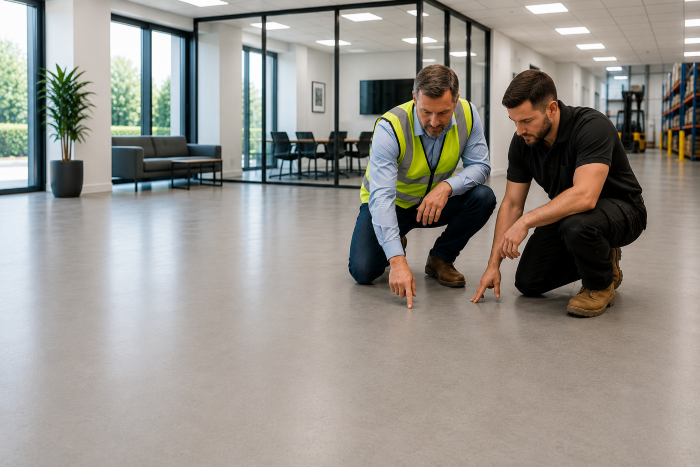
 A worn floor tells on a building faster than almost anything else. Scuffed vinyl at reception, lifting edges in a corridor, or a warehouse coating that cannot cope with daily traffic all send the same message - this space is not working as well as it should. That is why choosing the right commercial flooring contractors matters. It is not only about appearance. It is about safety, durability, workflow and how well your premises hold up under real business use.
For facilities teams, office managers and business owners, flooring tends to become urgent only when it starts failing. By that point, the pressure is on to replace or upgrade it without disrupting staff, visitors, production or trading. Good contractors understand that reality. They do not just install a product. They help you make sensible decisions about specification, programme, access and long-term performance.
What commercial flooring contractors should really bring to a project
There is a big difference between a contractor who can lay a floor and one who can deliver a flooring package in a live commercial environment. The second group looks beyond square metre rates and starts with how the space is used.
In an office, that may mean managing phased works around occupied departments, reducing noise, and ensuring finished areas are clean and ready for use quickly. In an industrial setting, it may mean working around machinery, loading schedules or restricted access zones. In both cases, practical planning matters just as much as workmanship.
Reliable commercial flooring contractors should be able to advise on subfloor condition, moisture issues, preparation requirements, slip resistance, maintenance expectations and the likely lifespan of different materials. They should also be realistic. If a cheaper option will wear out too quickly in a high-traffic area, you need to hear that before the order is placed, not six months after handover.
The right floor depends on how the space performs
One of the most common mistakes in commercial refurbishments is choosing flooring mainly by appearance. Visual finish matters, of course, especially in client-facing areas, but performance should lead the decision.
A reception area has very different demands from a staff kitchen, a meeting room, a production area or a mezzanine office. Carpet tiles may be ideal where you want comfort, acoustic improvement and easy future replacement of damaged sections. Luxury vinyl tiles can give a clean, professional finish in offices and breakout spaces, while offering good durability and straightforward maintenance.
Safety vinyl may be the better fit for washrooms, canteens or healthcare-style environments where slip resistance is a priority. Resin and specialist coatings can make more sense in industrial units where impact resistance, hygiene or chemical tolerance come into play.
The point is not that one product is best. It is that the best option depends on traffic levels, cleaning regimes, moisture exposure, wheeled loads, acoustic needs and how long you expect the space to serve its current purpose.
Why preparation often decides the result
A flooring finish is only as good as the surface beneath it. This is where experienced contractors earn their value.
Uneven subfloors, historic adhesive residue, cracks, damp and poor previous repairs can all affect the final installation. If these issues are ignored to save time, they tend to come back as visible defects, premature wear or outright failure.
Good preparation may include uplift of existing finishes, grinding, levelling compounds, moisture mitigation or localised repairs before the new floor goes down.
That can feel like an extra cost when you are trying to keep a project on budget. In reality, it is often what protects the budget from later remedial works.
Working in live environments without creating chaos
Most commercial premises cannot simply stop operating while flooring is replaced. Offices still need access, warehouses still need movement, and shared business spaces still have other occupants to consider. This is where project delivery becomes critical.
Commercial flooring contractors who regularly work in occupied buildings plan around people, not just around materials. They think about delivery routes, waste removal, dust control, noise, sequencing and temporary protection. They also understand that communication is part of the job. If teams know which areas are affected, when works are happening and when spaces will be handed back, disruption is easier to manage.
There is often a trade-off here. A faster programme may require evening or weekend working. A lower-cost programme may take longer if work has to be phased around business activity. Neither approach is automatically right. It depends on the cost of disruption to your operation and how critical the area is.
For many clients, the best outcome comes from a contractor that can coordinate flooring as part of a wider fit-out or refurbishment package. If ceilings, partitions, decorations and flooring all need attention, a joined-up programme usually causes fewer delays than bringing in multiple trades with competing schedules. That practical, managed approach is where firms such as Westwood Projects add real value.
Compliance, safety and long-term maintenance
Flooring decisions should stand up to more than the handover inspection. They need to support ongoing safe use of the building.
Slip resistance is one obvious issue, particularly in entrances, washrooms, kitchens and industrial settings. But it is not the only one. Fire performance, access requirements, transitions between different floor finishes, and suitability for cleaning products all matter. In some environments, there may also be sector-specific requirements around hygiene, static control or heavy-duty usage.
Experienced contractors should be able to talk through these practical compliance points in plain English. They should also help you avoid false economy. A finish that looks competitive at tender stage may carry higher cleaning costs, show wear quickly, or require more frequent replacement. Over several years, that can make it the expensive option.
Maintenance should never be an afterthought. Some floors are forgiving and easy to manage with standard cleaning routines. Others need more specialist care to retain their finish and lifespan. If your site team or cleaning contractor will not realistically maintain it in the recommended way, that should influence the specification.
Questions worth asking commercial flooring contractors
Before appointing anyone, it is worth testing how they think, not just what they charge. Ask how they would phase the works if parts of the building need to remain operational. Ask what subfloor risks they expect in a refurbishment rather than a new-build setting. Ask how they protect adjacent areas and how they manage dust, noise and waste.
You should also ask who is responsible for surveys, moisture testing and final specification. A vague answer can be a warning sign. So can a quote that looks attractive but says very little about preparation, making good or programme assumptions.
Past experience matters as well, especially if your building is busy, occupied or operationally sensitive. A contractor used to empty shell units may struggle in a live office or industrial site where cleanliness, communication and flexibility are non-negotiable.
Price matters, but so does the cost of getting it wrong
Every project has a budget. That is reality. But flooring is one of those packages where the cheapest figure can create the most expensive headache.
If the contractor has underallowed for preparation, rushed the programme, or specified a product that is wrong for the traffic levels, the result may fail early or disrupt your operation again far sooner than expected. Replacing a poor floor is rarely just a flooring cost. It can mean moving staff twice, rebooking other trades, delaying occupation or affecting day-to-day trading.
A better way to assess value is to look at the whole picture: suitability, programme, disruption risk, finish quality and likely lifespan. The right contractor will help you make that judgement clearly rather than pushing a one-size-fits-all answer.
Flooring as part of a better workplace
Commercial flooring is often treated as a finishing touch, but in practice it affects how a space feels and functions every day. It shapes first impressions for clients, comfort for staff, acoustics in open-plan areas, and durability in hard-working environments.
In refurbishments, it can also be one of the quickest ways to change the standard of a space without altering the building structurally.
That is why the best commercial flooring contractors do more than install a surface. They help businesses improve the way a premises performs, whether that means creating a smarter office environment, a safer circulation route, or a tougher floor finish in an industrial unit.
If you are planning flooring works, the sensible starting point is not the sample book. It is an honest look at how the space is used, what disruption you can tolerate, and what standard you need the result to meet. Get those answers right, and the flooring decision becomes far more straightforward.