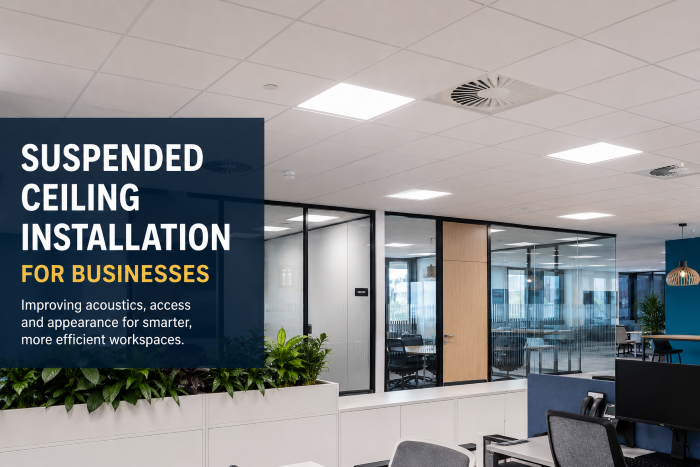
 When a workspace feels noisy, tired or awkward to service, the ceiling is often part of the problem. A well-planned suspended ceiling installation can change how a commercial space looks, sounds and functions without the disruption of major structural work.
For offices, industrial units, business centres and shared commercial premises, it is one of the most practical upgrades available.
What suspended ceiling installation actually delivers
A suspended ceiling sits below the structural soffit and creates a void for services such as lighting, data cabling, air conditioning ductwork, fire detection and other building systems.
In a busy office, the priority may be sound control and a cleaner finish. In a warehouse office or production support area, it may be about concealing exposed services while allowing access for maintenance.
Why suspended ceiling installation suits commercial refurbishments
For many businesses, the attraction is not just the finished appearance. It is the balance between performance, speed and cost.
This is why planning the ceiling in isolation rarely works as well as planning it as part of the whole fit-out. Lighting, air conditioning, partitioning and electrical layouts all interact with the ceiling.
Common reasons businesses upgrade their ceilings
A new ceiling is often triggered by one of a few familiar problems. The existing space may look dated, staff may be distracted by poor acoustics, or services may be exposed and badly routed.
Or a landlord reinstatement may require the premises to be returned to a compliant and presentable condition.
The process behind a successful suspended ceiling installation
A good installation starts with a proper survey, not a guess based on floor plans. Existing heights, structural details, service runs, access constraints and occupancy all need checking before any programme or price can be relied on.
Once the site has been assessed, the ceiling layout can be coordinated with lighting, air conditioning grilles, smoke detectors, sprinklers and any feature elements.
Choosing the right ceiling system
There is no single best suspended ceiling for every commercial project. Mineral fibre tiles remain a common choice because they are cost-effective, widely available and suitable for many office and general commercial settings.
Metal ceilings may be more appropriate where durability, hygiene or a sharper modern finish is needed. Plasterboard ceilings can deliver a cleaner visual result in selected areas, though access to services then needs to be resolved differently.
Acoustics, lighting and services coordination
Acoustic performance is one of the biggest reasons businesses notice the benefit of a new ceiling straight away. In open-plan offices and meeting areas, excessive reverberation affects concentration and makes conversations harder to follow.
A new ceiling is also the ideal opportunity to improve illumination levels, replace outdated fittings and create a more efficient lighting layout.
Working in live environments without unnecessary disruption
Most commercial clients do not have the luxury of closing their premises for refurbishment. Suspended ceiling installation can often be programmed with limited disruption, but only with the right planning.
Material deliveries, waste removal, access equipment and noisy activities all need managing carefully. Clean working practices matter as much as technical skill, particularly in occupied offices and customer-facing premises.
When suspended ceiling installation is part of a wider fit-out
A ceiling upgrade rarely sits alone. It often forms part of an office refurbishment, a fit-out within a new mezzanine, a CAT A to CAT B transition, or a dilapidation package before lease end.
If you are considering changes to your premises, it helps to look at the ceiling as part of how the building needs to perform, not just how it needs to look.