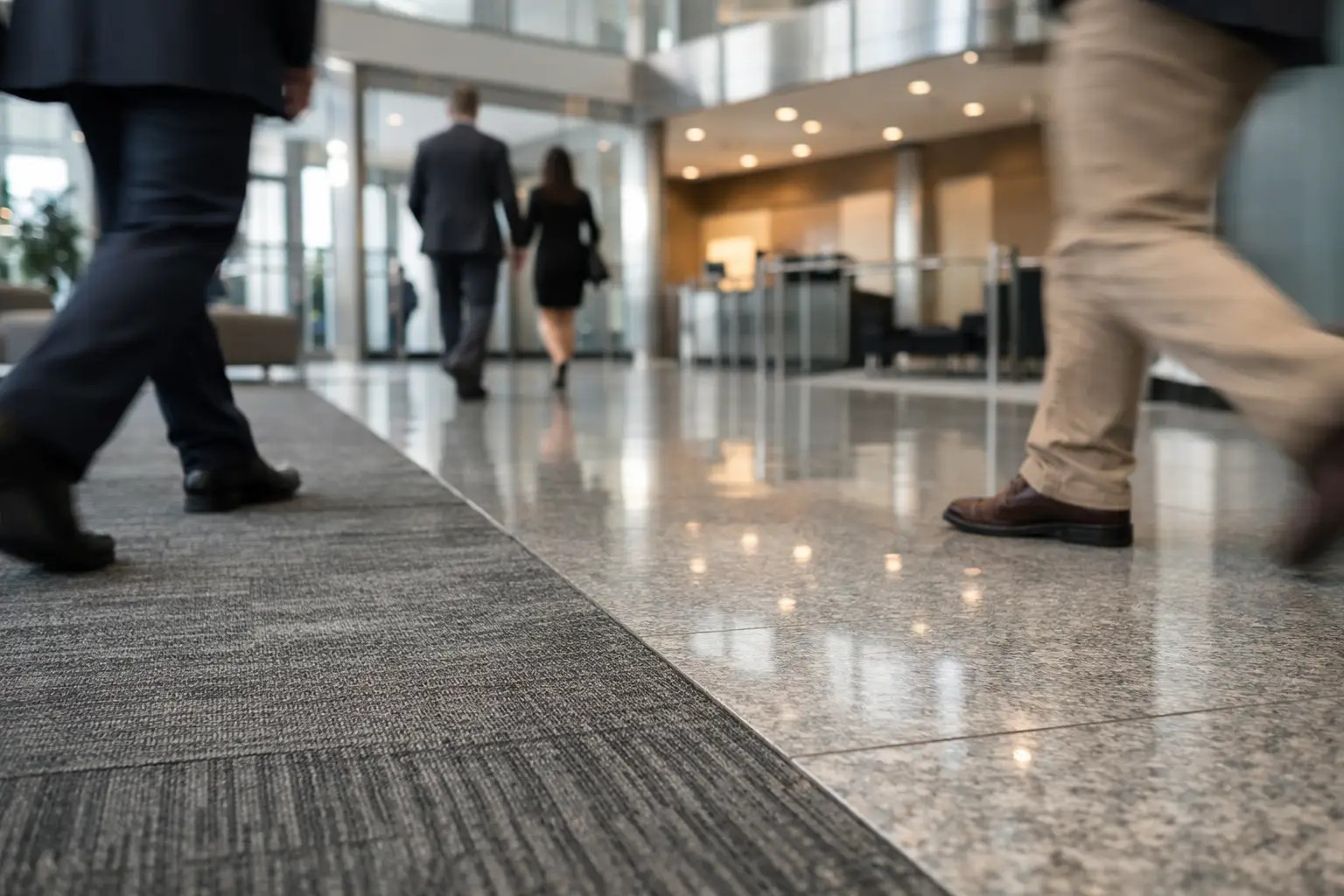
 A busy entrance can tell you more about a floor than a showroom sample ever will. Wet shoes, grit, chair castors, delivery trolleys and constant footfall quickly expose weak finishes and poor installation. Commercial flooring for heavy traffic needs to do more than look presentable on day one. It must support safe movement, stand up to the way your premises actually operate and remain practical to clean over the long term.
For facilities and operations managers, the right decision is rarely about choosing the hardest material in isolation. Traffic type, subfloor condition, cleaning routines, acoustics and downtime all affect which floor will give the best value. A well-planned flooring package should reduce maintenance pressure without creating disruption elsewhere in the workplace.
Start with the traffic, not the finish
“Heavy traffic” can mean very different things across commercial premises. An office reception may see hundreds of visitors, but its main challenges are dirt, moisture and appearance. A warehouse walkway may experience safety footwear, wheeled equipment and frequent impact. In a business centre, corridors need to cope with continual movement while helping to control noise between occupied offices.
Before selecting a product, consider where the pressure points are. Entrances, lift lobbies, kitchen areas, corridors, breakout spaces, washrooms and routes between production and office areas usually wear faster than the rest of the building. Flooring should be specified by zone where necessary, rather than applying one product across every area for the sake of simplicity.
The questions that matter are practical. Will the area receive water from outside? Are pallet trucks, roll cages or other wheeled loads involved? Do staff spend long periods standing? Is slip resistance a priority? Will the space remain in use during the works? Clear answers allow the flooring specification to match the building’s day-to-day demands.
Commercial flooring for heavy traffic: suitable options
There is no single best material for every busy workplace. The most appropriate choice depends on the use of the space, the required appearance and the level of maintenance your team can realistically maintain.
Luxury vinyl tile and sheet vinyl
Luxury vinyl tile, often referred to as LVT, is a strong option for offices, receptions, corridors and customer-facing areas. It offers a broad choice of timber, stone and contemporary finishes while being more resilient and easier to replace in localised areas than many natural materials. Quality commercial-grade LVT is designed to withstand regular footfall, but it still needs a sound, level subfloor and the correct adhesive to perform properly.
Sheet vinyl is particularly useful in washrooms, kitchens, healthcare-style environments and practical back-of-house areas. With fewer joints, it can provide a hygienic, water-resistant surface that is straightforward to clean. Slip-resistant options are available where moisture is a regular concern.
Carpet tiles
Carpet tiles remain a sensible choice for busy offices, meeting rooms and circulation routes where acoustics matter. They soften the sound of footsteps, improve comfort underfoot and can make large workspaces feel more settled. Individual tiles can also be lifted and replaced if they become stained or damaged, which is useful in areas with concentrated wear.
They are not the right answer for every location. Entrance zones and areas exposed to frequent wet contamination need effective matting and a suitable cleaning regime. Without this, dirt can be tracked through the building and shorten the life of the carpet.
Safety flooring and resilient surfaces
For industrial premises, workshops, kitchens, changing areas and service corridors, safety flooring may be the more appropriate solution. These surfaces are designed with enhanced slip resistance and can cope with demanding cleaning requirements. The trade-off is usually aesthetic choice: practical safety flooring is selected for performance first, although modern ranges provide more colour and finish options than many clients expect.
Rubber flooring can also work well where impact absorption, slip resistance and noise reduction are required. It is commonly considered for gyms, education settings, stairs and high-use circulation areas. Its upfront cost can be higher, but it can offer a long service life when specified and maintained correctly.
Resin and industrial floor coatings
In warehouses, manufacturing areas and operational spaces, resin flooring or specialist coatings can create a durable, joint-free surface. Depending on the system, it can be designed for chemical resistance, heavy loads, improved hygiene or clear demarcation of walkways and work zones.
Preparation is critical. A resin system is only as reliable as the concrete beneath it, so moisture levels, cracks, contamination and surface strength must be assessed before work starts. This type of installation may also require carefully managed curing time, which needs to be factored into operational planning.
The details that determine service life
A durable product can still fail early if the supporting details are overlooked. Subfloor preparation is one of the most important parts of any commercial flooring installation. Uneven screeds, moisture in concrete, old adhesive residues and movement in the existing floor can all lead to visible joints, lifting, cracking or premature wear.
Moisture testing should not be treated as an optional extra, particularly on ground-floor slabs or where a new screed has been laid. If readings are unsuitable, a damp-proof membrane or other remedial work may be needed before the new finish is installed. Taking this step early is less costly than returning to repair a failed floor after occupation.
Entrance matting deserves similar attention. It is one of the most effective ways to protect commercial flooring, because it removes water and abrasive dirt before it reaches the main surface. A properly sized, recessed or surface-mounted matting system can significantly reduce cleaning demands and preserve the appearance of adjacent flooring.
Transitions, door thresholds, stair nosings and skirting details also matter. These areas should be planned as part of the overall package, especially where flooring meets partitions, suspended ceilings, new doors or refurbished reception areas. A coordinated approach avoids untidy edges and last-minute compromises.
Balance durability with safety and appearance
The hardest floor is not always the best operational choice. Polished surfaces may look impressive in a reception but can become slippery when wet. Highly textured safety flooring may offer confidence underfoot but be more difficult to clean if it is used in the wrong environment. Dark finishes can disguise marks, while very light finishes may show scuffs quickly in a busy corridor.
Colour and pattern can be used practically, not just decoratively. Zoning can help direct visitors through a building, distinguish pedestrian routes from operational areas or highlight changes in level. In offices, flooring choices can support a more professional client experience while still allowing for the movement of desk chairs, cleaning equipment and daily staff traffic.
Where refurbishment works take place in occupied premises, phasing is equally important. Installing flooring out of hours, completing one zone at a time and maintaining safe access routes can reduce the impact on staff and visitors. The best programme depends on the building, but early coordination gives far more flexibility than trying to fit flooring around an already fixed schedule.
Plan maintenance before installation begins
Every commercial floor has a maintenance requirement. The aim is to select a finish that fits the cleaning regime you can sustain, rather than relying on intensive care that will not be practical six months after handover.
LVT and sheet vinyl generally need regular sweeping or vacuuming, prompt spill removal and suitable cleaning products that do not damage the protective surface. Carpet tiles benefit from regular vacuuming and planned periodic deep cleaning. Resin and safety floors may require specific cleaning methods to retain slip resistance and avoid residue build-up.
It is also worth retaining spare materials from the original installation. Batch variations can make future replacements more noticeable, particularly with patterned LVT, carpet tiles or coloured safety flooring. Holding a small quantity of matching product can make local repairs quicker and less disruptive.
A flooring project should work around your operation
The strongest commercial flooring projects are planned as part of the wider workplace, not treated as a final cosmetic layer. If you are reconfiguring office space, creating new partitions, upgrading electrical services or improving an industrial unit, the flooring programme needs to align with those works. Sequencing affects access, cleanliness, curing times and the quality of the finished result.
Westwood Projects can coordinate flooring within a wider commercial fit-out or refurbishment, helping clients manage the practical details from preparation through to completion. For busy premises, that joined-up approach can mean fewer contractor handovers, clearer communication and a cleaner route back to normal operations.
Choose a floor that reflects how people, equipment and visitors move through the building every day. When the specification is based on real use rather than appearance alone, the result is a safer, smarter workspace that continues to perform long after the installation team has left site.